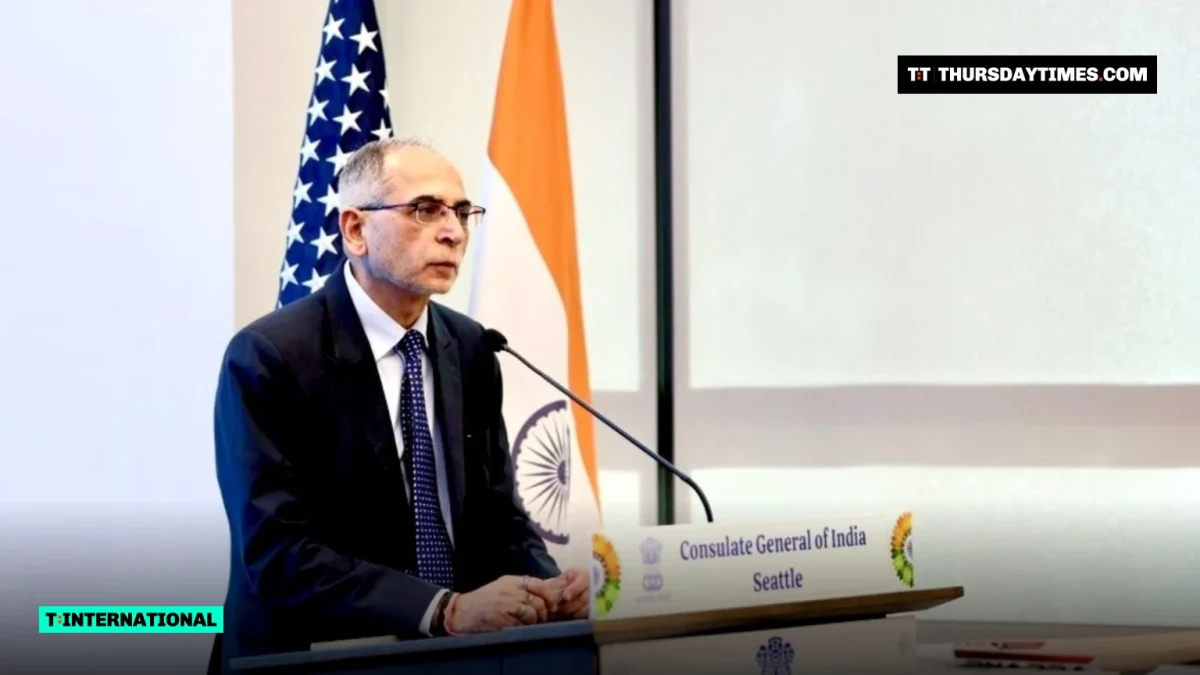
NEW DELHI (The Thursday Times) — India’s ambassador to the United States has rebuked the US Commission on International Religious Freedom (USCIRF) for describing Sharjeel Imam, an activist jailed since 2020, as a man detained for his religious freedom advocacy, saying the panel has “no locus standi” to judge the constitutional rights of Indian citizens.
In a post on X, Ambassador Vinay Mohan Kwatra called the commission’s assessments of India “habitual partisan, ill-informed, and jaundiced”, and said they could not “diminish India’s constitutional commitment to religious freedom and equal rights for all faiths”.
“Taking the same liberty that USCIRF so readily assumes, a word of advice: introspect on your own prejudices and stop lecturing others,” he wrote.
What the commission said
The commission, an independent US federal body that advises the government on religious freedom abroad, had shared Imam’s profile on X, describing him as a Muslim man detained in India for his religious freedom advocacy.
Its online profile lists the charges against him, among them criminal conspiracy, hate speech, terrorism, and sedition. It treats his detention as linked to his campaign against the Citizenship Amendment Act (CAA), which it regards as discriminatory. The post drew a wave of angry replies from Indian users on X.
Nearly six years in jail
Imam, a former doctoral student at Jawaharlal Nehru University in Delhi, was arrested in January 2020 over speeches he made during protests against the CAA in December 2019 and January 2020. Police accuse him of speeches that incited communal violence.
In August 2020 he was charged in the case over an alleged larger conspiracy behind the February 2020 riots in north-east Delhi, in which the former student leader Umar Khalid is also accused. The charges include offences under the Unlawful Activities (Prevention) Act, India’s main anti-terror law, and the case is being investigated by the Delhi Police Special Cell.
His bail applications have been rejected repeatedly, and his trial has yet to begin, according to reports. In October, a Delhi court allowed him seven days’ interim bail to attend a cousin’s wedding, and on October 10 it declined a police request to cancel that bail over an alleged breach of a condition barring him from contact with the media.
The row comes days after an Indian rights group said it had recorded 322 hate crimes against minorities in nine months. India has repeatedly rejected the commission’s criticism as biased.