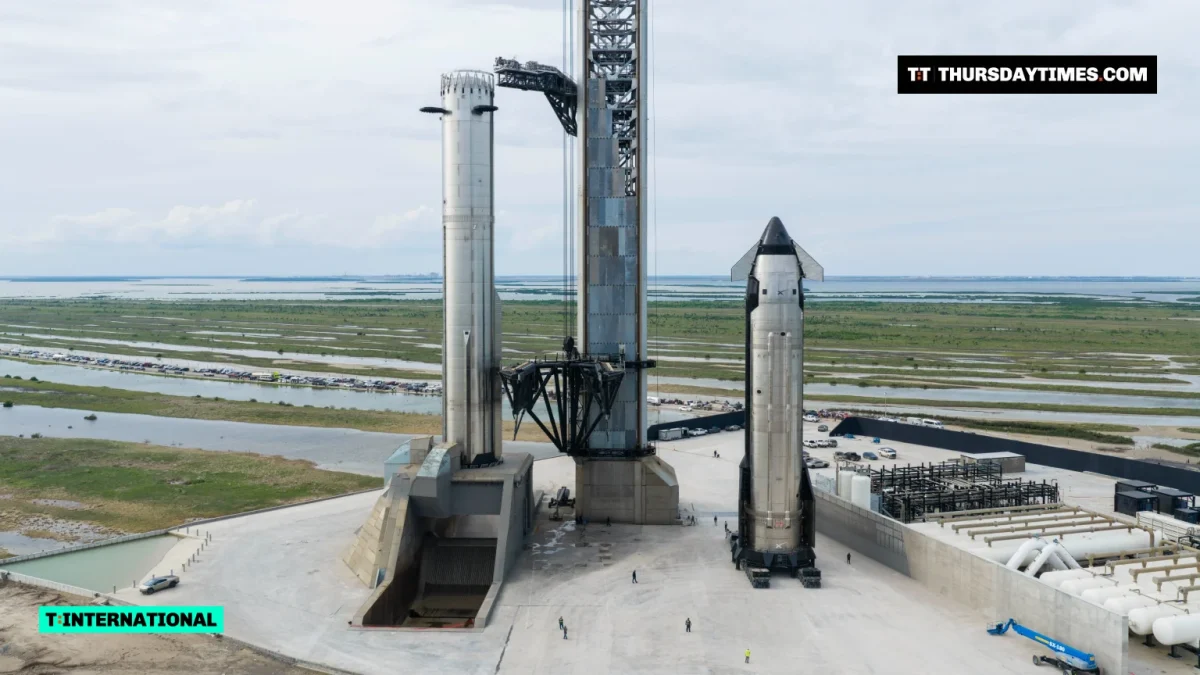
STARBASE (The Thursday Times) — SpaceX caught the upper stage of its Starship rocket with the arms of its launch tower in Texas on Saturday, the first time it has brought the ship back to the pad, after the vehicle spent nearly a day in orbit on its 15th test flight.
“Mechazilla catches Starship! Congratulations to the entire SpaceX team on this incredible achievement,” the company said on X after the ship, firing its engines, settled into the tower’s mechanical arms at Starbase, near Brownsville.
The catch rescued a flight that had been meant to recover both stages. The Super Heavy booster abandoned its own tower catch minutes after Friday’s launch, turned out over the Gulf of Mexico and exploded just above the water.
The ship reached orbit about 27 minutes after lift-off and released 26 Starlink V3 satellites, according to the company. It then coasted for roughly 22 hours before re-entering and flying back to the launch site.
A step towards reuse
SpaceX has caught Super Heavy boosters at the tower three times before, most recently in March 2025, but had never tried to catch the ship. Recovering both stages intact is central to Elon Musk’s plan for a fully reusable rocket that can fly far more often and far more cheaply.
Musk has said he expects Starship to launch weekly by the first half of 2027, and the company has said it could begin flights from a new launch pad in Florida by the end of this year.
NASA has paid SpaceX about $3.2 billion since choosing Starship in 2021 as the lunar lander for its Artemis programme, and the two expect it to put astronauts on the moon by 2028. Before then, SpaceX still has to show it can transfer fuel between Starships in orbit, a step the ship needs to reach the moon.