Karachi has done what a government does in the first week after a disaster. The head of the Sindh Building Control Authority (SBCA) has been removed, 16 of its officials have been suspended, 516 buildings have been sealed, and a case naming 10 people has been registered. Those steps were needed, and the Sindh government deserves credit for moving fast. But the city has been here before. A Lyari building fell in July 2025, killing 27 people, and an SBCA director-general lost his post then too. Removing a chief answers one collapse. Preventing the next takes a system: structural audits that do not answer to the builder, a public register of approved plans, liability for the people who approve, and somewhere for residents to go.
What the first week has delivered
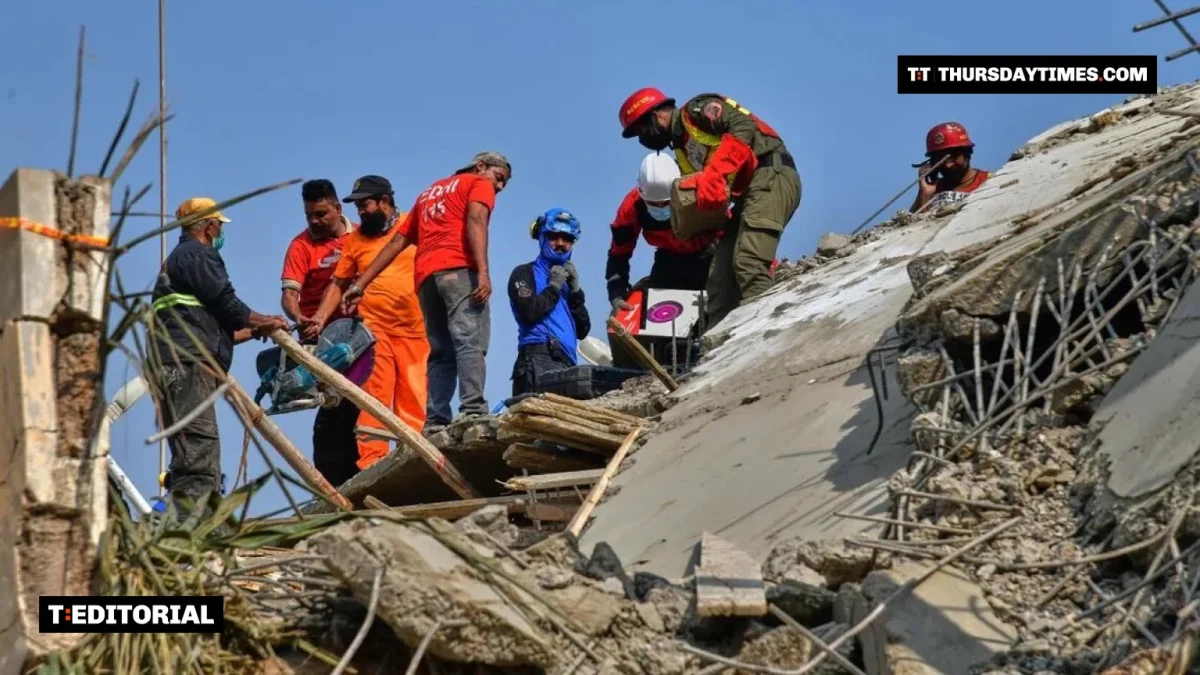
The building came down on Wednesday 25 November in the Karachi Administration Employees Housing Society, near Baloch Colony. It was under construction, six storeys high, on a 600-square-yard plot. At least 15 people have died, and officials said rescuers were still searching on the fifth day, working by hand because heavy machinery could bring down what remained of the structure. Many of those inside were workers, among them marble fitters.
The SBCA had approved a ground-plus-oneA building of a ground floor and one floor above it, so two levels in all. Plans are approved for a set number of floors, and anything built above that is a breach of the approval. structure. The owner built far beyond it, and when the authority ordered work to stop, he went to court and obtained a stay orderA court order that pauses an action, such as a demolition or a stop-work notice, until the case is decided. It does not by itself say that the building is legal or safe.. Karachi Mayor Murtaza Wahab said the authority had planned to demolish the building and could not because of that order. Chief Minister Murad Ali Shah called the collapse “criminal negligence”, not an accident.
Since then the provincial government has removed SBCA Director General Waseem Shamshad and appointed Abid Saleem in his place. It has suspended the East deputy commissioner and the East senior superintendent of police, and ordered 16 SBCA officials suspended. The chief minister has spoken of a reset of the authority, and the chief secretary has been told to bring the building’s architect and structural engineer into the inquiry. Police have named 10 people in a case that includes murder and negligence, and four have been arrested.
These are the right first moves. They are also the moves that follow almost every collapse, which is why the real question is what is left once they have been made.
A sacking answers one collapse. A system answers the next one.
Two collapses, two different failures
Set this week beside Lyari. The five-storey building that fell there in July 2025 was old, and it was on the authority’s own list of dangerous structures. It should have been emptied. The building in Baloch Colony was new and still rising. It should have been stopped. In one case the system failed to get people out; in the other it failed to halt work on a structure that had outgrown its approval.
A third collapse, in Karachi’s Soldier Bazaar in February, killed 16 people and was put down to a suspected gas explosion. Its cause was different again. Three disasters in less than 17 months do not share a single cause, and that is exactly why the answer cannot be a single sacking. The city needs rules that catch a failing old building, an illegal new one, and an approval that was never questioned.
Three collapses, one plot, one list
Figures as given by officials and rescue services. The Baloch Colony toll is still being counted. The 588-building list covers Karachi as a whole, and the second and third figures are from a meeting of the local government minister’s committee on 15 July 2025. Bars are scaled within each group, not across groups.
Audits that do not answer to the builder
A building’s safety should not depend on the honesty of the person paying for it. The first reform is an independent structural auditAn inspection by a qualified engineer of whether a building’s foundations, columns, beams, and slabs match the approved design and can carry the load placed on them., done at the stages that matter: the foundation, the columns and slabs as they are poured, and before any floor above the approved height. The engineer should come from a rotating panel of registered professionals and be paid from a fee the authority collects, not by the builder. Each stage certificate should be a condition for the next stage. No certificate, no further work.
Sindh has already tried a version of this under pressure. After Lyari, the local government minister ordered a fresh survey of every building listed as dangerous, after acknowledging that some might have been wrongly categorised. District committees were told to include representatives of the builders’ association, the Pakistan Engineering Council, and the Pakistan Council of Architects and Town Planners. That was the right mix. At the committee’s first meeting, 59 of the 588 listed buildings were classed as extremely hazardous, and 29 of those had been vacated.
The numbers show both the scale of the task and the reason outside engineers matter. When the minister himself says a list may be wrong, and doubts are raised about how the authority’s own staff assess buildings, the answer is a second pair of eyes that has no stake in the result. A panel like that should not need a collapse to assemble. It should be permanent, funded, and publicly named.
A register anyone can read
The simplest tool is a public register. Every approval should be entered in an online record that anyone can search by plot number: the approved floors, the architect and engineer who signed, the date, and the status of any court order. The same facts should be printed on a board at the site gate. A building that is six storeys tall on a plot approved for two is visible from the street. A board at the gate would turn every neighbour, buyer, and passer-by into an inspector.
If the approved height is written on the gate, everyone who walks past is an inspector.
The register should carry stay orders too. The chief minister said construction had been halted on 123 buildings being built under court stays, and that the government had asked the court to decide their status within 15 days. Stay orders are a legitimate remedy, and courts must be free to grant them. But a stay that protects a building from demolition should not also freeze the safety checks on it. An audit should be able to go ahead while the case is pending, and cases about buildings under construction deserve a fast listing, because the cost of delay is paid by whoever is inside when the next slab goes up.
Liability that reaches the approver
After Lyari, the case named nine SBCA officials as well as the building’s owner. Reports on this week’s case say it lists the owners, the builder, the architect, the structural engineer, and the contractors, and does not name officials of the authority. The inquiry is meant to reach further, and it should. The administrative action so far, removals and suspensions, is a personnel decision. Liability is a deterrent, and it only works if it is certain.
Every approval and stage certificate should carry the name and registration number of the SBCA officer and of the private engineer who signed it. Those signatures should mean something in law. If a floor is certified that is not in the plan, or a slab is passed that nobody inspected, the signer answers for it, as quickly as the owner does. Honest officials gain from this too, because a clear paper trail protects them from blame for what they did not sign, and from pressure to sign what they should not.
Pressure is the point the mayor himself raised, speaking of political influence behind the construction and of the portion mafiaA term used in Karachi for networks that add extra floors or sell separate portions of plots without proper approval, often on small residential plots. that had cost the city so dearly. Those who lean on an official to look away should be as easy to trace as those who sign. A register of approvals, with names, makes that possible.
A signature that carries no liability is only a decoration.
People before the padlock
The sealing of 516 unauthorised buildings in about 36 hours shows a state that can move when it chooses to. Buildings that broke the rules deserve it. But the Association of Builders and Developers of Pakistan says about 150 of its member projects were sealed despite having official approvals, and has threatened to suspend construction from Monday unless they are reopened. The commissioner’s office did not specifically address that claim. Both sides need a rule, not a standoff. A sealed project with approvals should be audited by the independent panel within days, and reopened with a certificate if it passes. A builder with nothing to hide gains from the register. A strike by the industry is not an answer to a collapse that killed people working on a building site.
Residents are the party most easily forgotten. After Lyari, the government announced three months of rent support for families displaced from vacated buildings and from the Baghdadi area. That was a start, but re-certifying or rebuilding takes longer than three months, and a family told to leave a building cannot simply be told to leave. A credible plan needs a rental allowance that lasts until people can return or resettle, transit housing where rents are out of reach, and a clear route for flat buyers whose projects are sealed to recover what they paid. The families of the dead, many of them workers who were on the site, need help that is announced, paid, and published.
A test for the next 30 days
None of this needs a new institution. It needs the existing ones to publish, connect, and finish what they have announced. In the next month a handful of plain questions can be answered. Is the register of approved plans online, and does it show court stays? Has the court decided the 123 stay cases? Which engineers sit on the audit panel, and who pays them? How many of the 516 sealed buildings have been audited, and how many have been reopened or emptied? Will the inquiry’s findings, including those on the people who approved the plans, be made public? And where are the displaced families living tonight?
The chief minister has said he will not tolerate loss of life from incidents like this one. The test is whether that sentence becomes a rule that outlasts the director-general who was removed, the officials who were suspended, and the news cycle. Karachi has acted quickly in the first week. A city of this size cannot rely on a first week. It needs an engineer who answers to the public, a register anyone can read, a signature that carries consequences, and a roof for the people left outside. Those four things are the difference between a crackdown remembered for the announcement and one remembered for the collapse that did not happen.