Editorial

And we’ll keep on fighting til’ the end

From crisis, isolation and doubt, Pakistan has stepped into the diplomatic centre of gravity. If the US-Iran peace framework holds, Islamabad will not merely have brokered a deal. It will have reminded the world that nations are not condemned to the reputations others write for them.
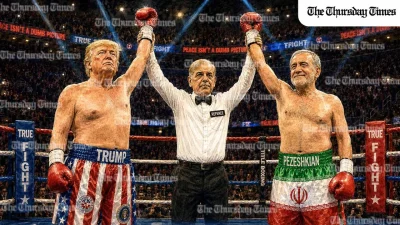
If this peace holds, Pakistan will have done more than broker an agreement. It will have recovered a part of its own national imagination. — MICHAEL MCCALL FOR THE THURSDAY TIMES

Pakistan’s mediation role ≠ Israeli normalisation

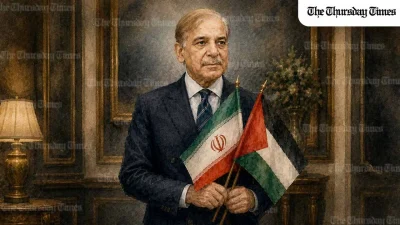
Pakistan’s role in de-escalation does not amount to acceptance of normalisation with Israel. Islamabad’s Palestine policy remains rooted in statehood, Al-Quds, and pre-1967 borders, not the politics of the Iran file.

Trump’s attempt to link an Iran settlement with Abraham Accords expansion places Pakistan in a position it has long refused: treating Palestine as a transactional file. — MICHAEL MCCALL FOR THE THURSDAY TIMES

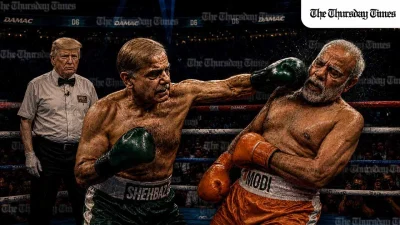
India debates while Pakistan mediates

Senior RSS and military remarks in India have reopened the question of dialogue with Pakistan, exposing the limits of New Delhi’s hardline public posture. At the same time, Islamabad is trying to show that its relevance now extends beyond India, through crisis diplomacy involving Iran, the US, the Gulf, China and multilateral finance.

India’s debate over reopening dialogue with Pakistan comes as Islamabad tries to recast itself as a diplomatic corridor for wider regional and global crises. — MICHAEL MCCALL FOR THE THURSDAY TIMES

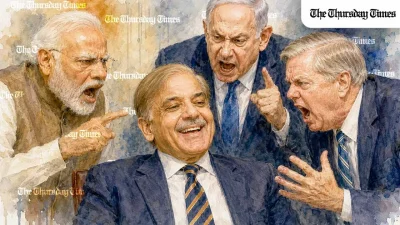
Pakistan’s diplomatic prowess has made it a target

Pakistan’s growing diplomatic relevance has triggered a sharper narrative war, with foreign criticism, hostile media framing and domestic security incidents being used to cast Islamabad as unstable just as it re-enters the centre of regional diplomacy.

From Netanyahu’s remarks to CBS reporting, Lindsey Graham’s criticism, Indian media amplification and renewed attacks inside Pakistan, the pattern is no longer easy to dismiss. Islamabad’s new diplomatic visibility has triggered a sharper contest over narrative, credibility and power. — MICHAEL MCCALL FOR THE THURSDAY TIMES

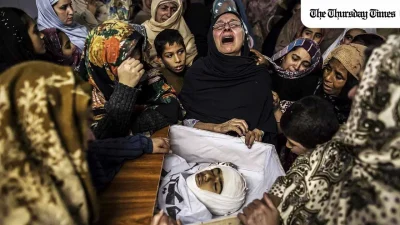
Selective outrage

From South Waziristan to Balochistan and Punjab, Pakistan continues to confront terrorist violence that targets security forces and civilians alike. Yet while the world speaks loudly for other states' victims, Pakistani suffering too often receives silence, indifference, or selective concern.

From South Waziristan to Balochistan and Punjab, Pakistan continues to face terrorist violence that targets civilians and security forces alike. The world cannot claim to defend human rights while ignoring Pakistani victims. — FILE
The Fall of Kabul was not only a military and political failure. It became a prolonged human crisis, with Afghan refugees pushed into Pakistan while America and Britain moved slowly on the promises they had made. — MICHAEL MCCALL FOR THE THURSDAY TIMES

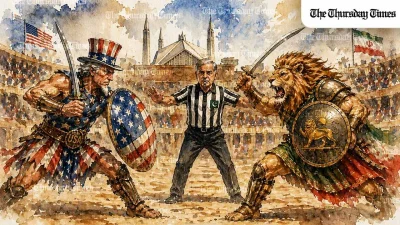
The world capital of diplomacy awaits its Gladiators

Will there be a second Islamabad Talks? Undoubtedly. The notion of an Islamabad Talks 2 have not materialised on cue, but that doesn't mean the process is dead. It means Pakistan holds the only channel both the U.S. and Iran can still use.

Pakistan’s role in Islamabad Talks 2.0 is being tested by silence, delay and hard bargaining. The real diplomatic work may only just be starting. — MICHAEL MCCALL FOR THE THURSDAY TIMES

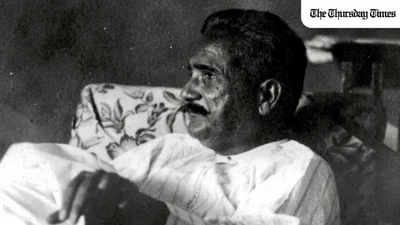
The tragedy would be to celebrate Iqbal and ignore him

On the 88th death anniversary of Allama Iqbal, it is worth asking not only what he meant to the making of Pakistan, but what his ideas demand of the country now. As Islamabad tries to keep open channels between Iran and the United States, Iqbal’s poetry feels less like memory and more like instruction.

Iqbal’s legacy is often confined to tributes, school recitations and official speeches. But his real significance lies in how he taught Muslim societies to think about dignity, agency and purpose. In Pakistan’s present diplomatic moment, those ideas feel newly relevant. — FILE

Moving beyond survival

After years of being defined by debt scares, bailouts and economic uncertainty, Pakistan is showing signs of a broader recovery marked by renewed market access, stronger investor confidence, diplomatic relevance and momentum that isn't stopping anytime soon.

A string of positive developments suggests Pakistan may be entering a new chapter after years of economic strain. Market access, investor confidence and diplomatic relevance are beginning to replace the language of crisis. — MICHAEL MCCALL FOR THE THURSDAY TIMES

When rivals need a bridge, they still call Islamabad

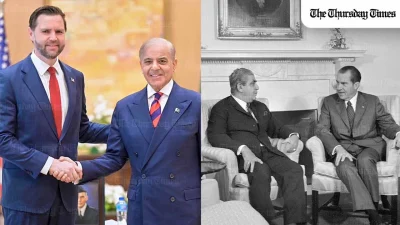
Pakistan’s emergence as the setting for U.S.-Iran diplomacy in 2026 was not a sudden stroke of luck but the return of an older strategic role; long before officials sat across from one another in Islamabad, Pakistan was already the back channel by which messages, assurances and ceasefires were carried.

What Islamabad demonstrated in 2026 is not merely diplomatic agility, but institutional memory. The methods may have evolved, the actors may have changed, but the underlying approach remains consistent. — MONTAGE/THE THURSDAY TIMES
Published by Thursday Media International thursday.media