TT Monitoring Desk

Reports from The Thursday Times' in-house monitoring desk.

Field Marshal Munir played a central role in US-Iran mediation, New York Times

The New York Times reported that Field Marshal Asim Munir played a central role in US-Iran mediation and his overnight Tehran visit was an intensification of shuttle diplomacy. The Thursday Times traces how Pakistan's army chief built the trust of both Washington and Tehran, one visit at a time.

Field Marshal Asim Munir meets US President Donald Trump alongside Prime Minister Shehbaz Sharif at the White House in September 2025, a relationship that would later place Pakistan at the centre of US-Iran peace mediation. — FILE/THE WHITE HOUSE

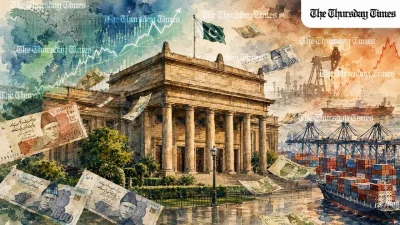
Pakistan’s economy has stabilised, but now the hard part begins

The State Bank of Pakistan’s Half Year Report shows stronger growth, lower inflation, rising reserves and a rare fiscal surplus, but warns that weak exports, low investment, climate shocks and Middle East instability could still test the recovery.

The SBP Half Year Report shows Pakistan’s growth picking up, inflation easing and reserves improving, but weak exports, climate risk, low investment and Middle East instability still threaten the recovery. — MICHAEL MCCALL FOR THE THURSDAY TIMES

پاکستان نیوی نے بھارتی درخواست پر بحیرہ عرب میں پھنسے بھارتی جہاز کو ریسکیو کیاپاکستان نیوی نے بھارتی درخواست پر بحیرہ عرب میں پھنسے بھارتی جہاز کو ریسکیو کیا، دی ہندو

پاکستان نیوی نے بھارتی درخواست پر بحیرہ عرب میں پھنسے بھارتی جہاز ”ایم وی گوتم“ کے عملہ کو انسانی بنیادوں پر فوری و تکنیکی امداد فراہم کی۔ پاکستان نیوی نے گزشتہ ماہ بھی بحیرہ عرب میں ایک تجارتی جہاز کے 18 رکنی عملہ کو ریسکیو کیا۔

Pakistan Navy provided humanitarian assistance to the stranded crew of Indian vessel MV Gautam in the Arabian Sea after a distress request from Mumbai, supplying food, medical aid and technical support to six Indian nationals and one Indonesian national. — MONTAGE/THE THURSDAY TIMES

Pakistan battles the clock to revive Iran-U.S. talks

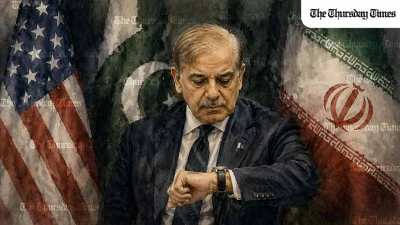
Pakistan is working against a rapidly closing deadline to revive U.S.-Iran diplomacy before the current truce expires. But fresh escalations at sea, conflicting public messages and Iran’s refusal to negotiate under pressure are making Islamabad’s peacemaking effort far more difficult.

Pakistan is making an urgent diplomatic push to bring Iran back to talks with the United States before a fragile truce expires, amid naval tensions and rising mistrust. — MICHAEL MCCALL FOR THE THURSDAY TIMES

Trump wants to go to Pakistan. That’s why Vance has to stay home

Donald Trump has long favoured high-profile diplomacy and may want to fly in himself if Pakistan offers the chance for a final deal or landmark announcement, meaning JD Vance would likely need to stay home in Washington or return from Islamabad first.

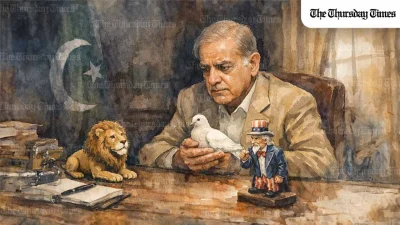
The White House’s changing signals on JD Vance’s Pakistan trip may reflect more than diplomacy, with security planning and the prospect of a Trump visit shaping the uncertainty. — MONTAGE/THE THURSDAY TIMES

The road to Islamabad

From calls with Tehran and Gulf capitals to ceasefire diplomacy and marathon talks in Islamabad, Pakistan has inserted itself into the most delicate phase of the U.S.-Iran crisis and emerged as an unlikely broker of dialogue.

Pakistan helped secure a ceasefire that halted direct confrontation, at least temporarily. It brought both sides to the table for the most senior direct talks in decades. And it prevented the collapse of diplomacy after the first round ended without agreement. — MICHAEL MCCALL FOR THE THURSDAY TIMES

The Islamabad Talks did not fail. They opened the next phase

The Islamabad Talks were never designed to deliver an instant grand bargain between Washington and Tehran. Their significance lies in something more foundational: they preserved the ceasefire, brought both sides face to face, defined the central sticking point and opened the door to a second phase of diplomacy.

To call the Islamabad talks a failure is to misunderstand the nature of diplomacy itself. High-stakes negotiations, especially between adversaries who have not engaged at this level in decades, do not culminate in instant breakthroughs. — FILE
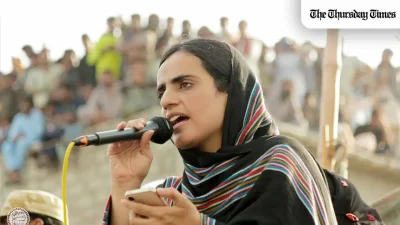
The issue is no longer simply whether Baloch grievances exist, but whether western outlets are flattening a violent and legally complicated landscape into a morality play with one heroine and one villain. — FILE/THE THURSDAY TIMES
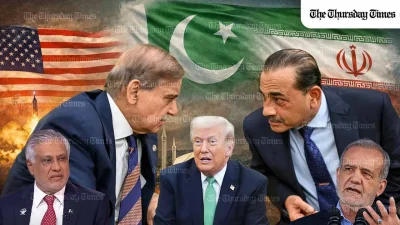
Pakistan is intensifying quiet diplomacy with Washington, Tehran and Gulf capitals in an effort to prevent the US-Israel-Iran conflict from spiralling further and to position Islamabad as a possible venue for peace talks. — COLLAGE/THE THURSDAY TIMES

The BBC’s one-sided Kandahar narrative

A broadcaster like the BBC must do more than relay claims; it must test them. When it gives one side’s language prominence while sidelining the other’s evidence and security case, it stops just reporting and starts shaping a narrative.

Audiences today are not passive. They compare footage, statements, satellite imagery, and open-source analysis in real time. — FILE/THE THURSDAY TIMES