WASHINGTON (The Thursday Times) — Five Indian-origin Republicans were on the ballot for governor, attorney general and Congress on Tuesday. All five lost. Vivek Ramaswamy was beaten for governor of Ohio, a state Donald Trump carried by 11 points two years ago. Saritha Komatireddy lost the race for New York attorney general. Ritesh Tandon, Nirav Sheth and Mahesh Ganorkar lost their House races in California, Washington and North Carolina.
On the same night, Indian-origin Democrats won almost everywhere they stood, from a newly drawn seat in Florida to a Republican-held one in Arizona. Voters did not reject Indian-origin candidates. They rejected these ones, and the party they ran for: a party whose base spent the year telling Indian Americans they did not belong, and whose best-known Indian-origin candidate ran one of the ugliest campaigns of the cycle.
The night in four numbers
Ohio: the race that set the tone
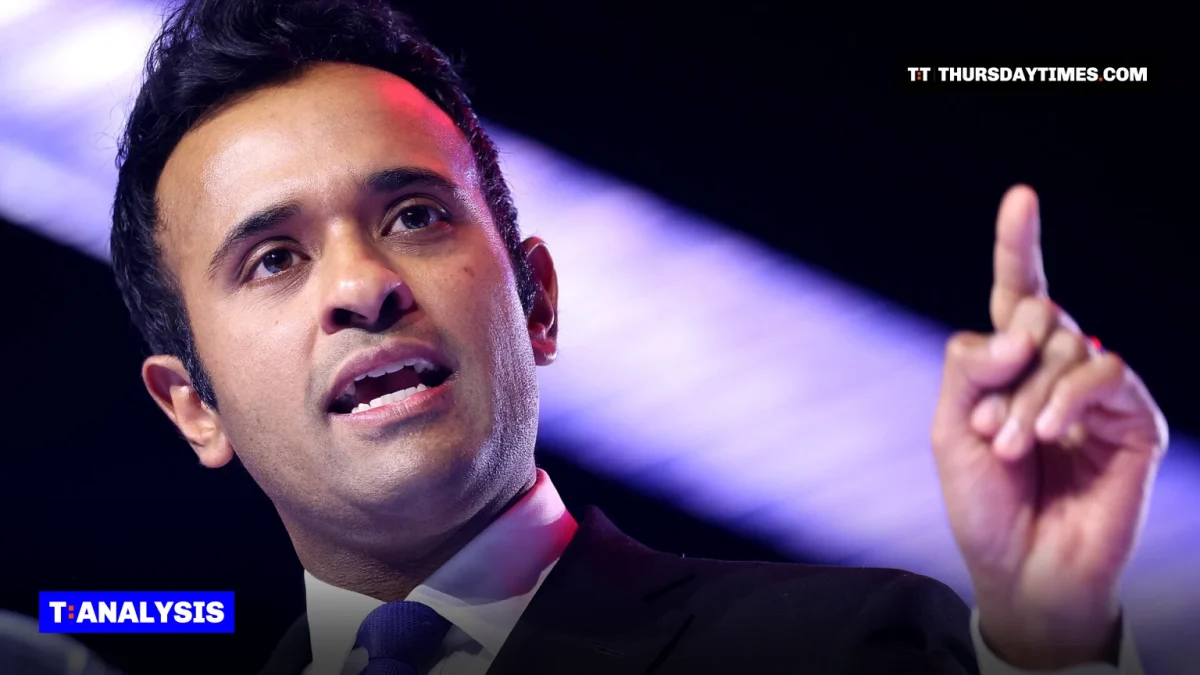
Ramaswamy, a 41-year-old biotech billionaire with Trump’s endorsement, was supposed to be a safe hold. Ohio had not elected a Democratic governor since 2006. He put more than $36 million of his own money into the race and had the backing of Trump and Elon Musk. He lost to Amy Acton, the physician who led the state’s pandemic response, by about 51 per cent to 46, and she becomes Ohio’s first woman governor.
The turning point was an advertisement. In late October his campaign aired an ad featuring Acton’s long-estranged mother, who accused her daughter of lying about her childhood. The mother had lost custody of Acton after the girl’s stepfather was charged with sexually abusing her. Mike DeWine, Ohio’s Republican governor, called the ad “deeply troubling” and urged him to pull it. Trump called it “powerful”. The campaign eventually stopped airing it, but by then it had done its damage with moderate and independent voters.
“It is a tough and challenging night for Republicans across the country and it is a tough night for us here in Ohio,” Ramaswamy said as he conceded. He did not say what had gone wrong. Observers in the state pointed to the ad, to a campaign that attacked far more than it proposed, and to his closeness to a president dragging his party down with an unpopular war with Iran and rising prices. Ramaswamy staked his career on Trump. On Tuesday the bill arrived.
Four more defeats
In New York, Komatireddy, a former federal prosecutor who once clerked for Brett Kavanaugh, ran with Trump’s endorsement against Letitia James, the attorney general who has spent years taking his administration to court. James won a third term by about 60 per cent to 40. Conceding, Komatireddy said she was proud of a campaign that had shown politics need not be defined by “division and hate”.
The three House races were never close. In Silicon Valley, Tandon lost to Ro Khanna by more than 42,000 votes in a contest between two Indian Americans. In Seattle, Sheth, a former Marine, took 12.1 per cent against Pramila Jayapal’s 87.5. In North Carolina’s 4th district, Ganorkar lost to the Democratic incumbent, Valerie Foushee.
How far behind they finished
Share of the vote, per cent. Ohio at the race call; New York and Washington with most votes counted. Ro Khanna beat Ritesh Tandon by more than 42,000 votes, and Valerie Foushee beat Mahesh Ganorkar.
The same voters, the other party
If this were a verdict on Indian-origin candidates, the Democrats would have lost too. They did the opposite. Pia Dandiya, a former school principal, won Florida’s newly drawn 22nd district with about 52 per cent. Amish Shah, a physician, took a Republican-held seat in Arizona with 52.5 per cent. Suhas Subramanyam held his seat in Virginia, Ami Bera won an eighth term in California, and Khanna and Jayapal were re-elected. In Maryland, Aruna Miller won another term as lieutenant governor with 62.6 per cent. In Los Angeles, Nithya Raman unseated Karen Bass to become the city’s first Indian American mayor.
The informal group of Indian American lawmakers known as the Samosa CaucusThe informal name for the Indian American members of the US House of Representatives, coined by Congressman Raja Krishnamoorthi. All of its members are Democrats. ends the election with two new members, Dandiya and Shah, despite losing Shri Thanedar in a primary. Every one of them is a Democrat.
“The 2024 Republican gains among this important constituency have not held.”
A survey of Indian Americans by the Carnegie Endowment for International Peace, taken in October, saw it coming. It found 62 per cent of Indian American citizens planned to back the Democrat in their House race and 19 per cent the Republican, a 43-point gap, wider than the 32 points by which Kamala Harris led Trump in the community in 2024. The swing was sharpest among the voters Republicans had worked hardest to win: men over 40, whose support for the Republican candidate fell to 16 per cent, from 32 per cent for Trump in January.
Indian American citizens backing the Republican side
Per cent. Earlier waves asked about the presidential vote, October 2026 about House races. Carnegie Endowment for International Peace and YouGov, Indian American Attitudes Survey; 1,000 adults, margin of error ±3.87 points.
A party that told them they did not belong
The numbers have a backstory. In September, Bo French, the Republican nominee for the Texas Railroad CommissionDespite its name, the elected three-member body regulates Texas’s oil and gas industry, not its railways., posted a photo of South Asian students celebrating a University of Texas football win and wrote: “I heard UT graduation this year looked like this. I didn’t believe it.” In another post he said social media was exposing “how many Americans have been displaced by foreigners”. John Cornyn, the state’s Republican senator, called it “intolerance and racism”. Karl Rove, the party’s veteran strategist, called French a bigot. French refused to apologise. On Tuesday he lost to the Democrat Jon Rosenthal by 52.8 per cent to 45.5, ending more than three decades of Republican control of the commission.
It went to the top. In April, Trump reposted on Truth Social a screed claiming that migrants come from “China or India or some other hellhole on the planet”. India’s Ministry of External Affairs called it “uninformed, inappropriate and in poor taste”, an unusually sharp rebuke of an American president. The Hindu American Foundation said it was “deeply disturbed”.
All this landed on a community already on edge. A September report by Stop AAPI Hate found that anti-South Asian slurs in monitored online spaces rose 109 per cent between January 2023 and December 2025, and that 48 per cent of South Asian adults said they had faced a hate act in 2025. Running through it all was the fight on the American right over H-1B visasUS work visas for skilled foreign professionals. Indians receive the large majority of them, which has made the programme a target in the Republican fight over immigration., which has made Indian professionals a favourite target for the party’s nativist wing.
Some of the party’s own walked. Vasant Bhatt, a 21-year-old University of Houston student who had campaigned for Republicans including Ted Cruz, switched to the Democrat James Talarico in the Senate race, which Talarico won.
“I will not tolerate being treated as a perpetual foreigner in the country I call home.”
What it means for New Delhi
For India, the night carries a message beyond the diaspora. Narendra Modi built his American strategy around a personal bond with Trump, from the “Howdy, Modi!” rally in Houston in 2019 to “Namaste Trump” in Ahmedabad in 2020, and around groups such as Hindus for Trump that sold that bond to Indian American voters.
That model has now taken two blows in a year. Trump’s “hellhole” post drew a rare public rebuke from New Delhi, and the Indian-origin Republicans who might have carried the relationship into Congress have all lost. The Indian Americans in the new Democratic majority include Jayapal, who in 2019 sponsored a House resolution urging India to lift its communications blackout and mass detentions in occupied Kashmir.
None of this means Washington will turn on India. The strategic reasons both governments give for the partnership, from China to supply chains, are unchanged. But the politics around it have shifted. The Indian American community is no longer a dependable pipeline into the Republican Party, and the party is no longer a comfortable home for it.
Nalin Haley, the son of the former UN ambassador Nikki Haley, summed up the night for his party: “Democrats didn’t win, Republicans lost.” For the five Indian-origin Republicans on the ballot, that was true in the most literal sense.