On the night of August 14, 1947, a voice from Peshawar told the Frontier in Urdu and in Pashto that Pakistan had been born. Seventy-six years later, in May 2023, the building that carried that voice was looted and set on fire, and with it went much of what the station had recorded since. An anti-terrorism court in Peshawar is still hearing the case, and on Wednesday it reissued arrest warrants and adjourned until November 17. The trial must run its course. But the state does not need to wait for a verdict to do the other half of the job, which is to find, save and share whatever survives of one of the richest sound archives in the country.
What burned in Peshawar
Radio Pakistan Peshawar is among the oldest broadcasting stations in the country, with roots that go back to 1935. For most of its life it was the place where the music of the north-west was not only played but made. Singers came to its studios from villages across the province and beyond. Poets read their work into its microphones. Playwrights wrote radio dramas in Pashto and HindkoThe language of Peshawar’s old city and of Hazara division, spoken by several million people and closely related to Punjabi and Saraiki. that whole families gathered to hear. Speeches, interviews and news bulletins from the critical moments of the last eight decades, including the war of 1965 and the long years of conflict in Afghanistan, were kept on its shelves.
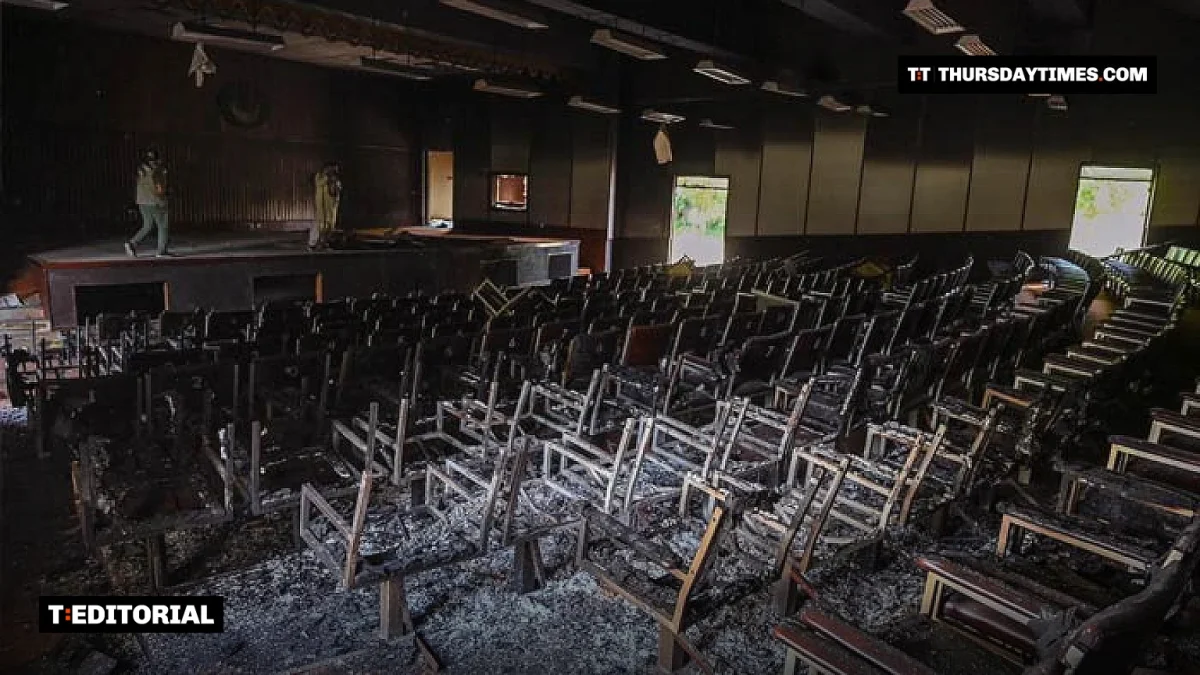
When rioters stormed the four-storey Broadcasting House on May 9 and 10, 2023, they did not stop at breaking windows. A senior producer at the station said at the time that 80 per cent of the building had been damaged and most of its rooms destroyed by fire. Four of the station’s vehicles were burned. The offices of the state news agency on the top floor were also damaged. A few days later the station director told visiting students that all the records, historical voices and pre-Partition music in the building had been burned. Reporting on the court case this week again described archives holding decades of Pashto and Hindko music, dramas and speeches as lost.
The damage to Broadcasting House, May 2023
Sources: Radio Pakistan Peshawar staff, May 2023; Pakistan Broadcasting Corporation, September 2026.
No one has yet published a full inventory of what was destroyed, how many tapes and discs were on the shelves, how much had already been copied elsewhere and what, if anything, was pulled out of the ashes. That absence is the first thing to fix.
“A rebuilt studio can broadcast tomorrow. A burned recording of a singer who died decades ago cannot be made again.”
Credit where it is due
The state has done the visible part well. The Pakistan Broadcasting CorporationThe statutory body that runs Radio Pakistan’s national and regional stations, its news service and its external broadcasts. says transmission from Peshawar was back on air within 26 hours of the attack. In September this year the Information Minister, Attaullah Tarar, opened the rehabilitated building, restored in five months and 26 days at an estimated cost of Rs100 million, with a museum inside. That speed deserves acknowledgement, and the museum is a fitting idea for a building that carries so much of the province’s memory.
But a building is the easy part. A rebuilt studio can broadcast tomorrow. A burned recording of a singer who died decades ago cannot be made again, unless a copy exists somewhere else. The real question is how many such copies exist, and who is going to look for them.
Rebuilt, and still to recover
Sources: Pakistan Broadcasting Corporation; court reporting, November 2026.
The copies are out there
Broadcast archives are rarely as unique as they look. For decades, programmes recorded in Peshawar were shared with other Radio Pakistan stations and with the national headquarters. Others may survive in the libraries of foreign broadcasters that once exchanged programmes with Pakistan. Many artists and their families kept their own copies of their performances, often on reel or cassette. Collectors in the old city have built private libraries of folk music over a lifetime. One Afghan refugee in Peshawar’s Board Bazaar has spent decades assembling around 2,000 master cassettes of Afghan folk singers, many of whom are no longer alive. There will be others like him, and some of what they hold will have started life in Radio Pakistan’s studios.
The diaspora matters too. Pashtun families in the Gulf, Britain and North America took recordings with them, copied them for relatives and, more recently, uploaded them to the internet. Much of this material is poor in quality and badly labelled, but some of it will be the only surviving copy of a performance. The longer the search is put off, the more of these tapes will be thrown away, the more of the older singers and producers who could identify them will die, and the more of it will decay beyond rescue. Magnetic tape does not wait.
“The longer the search is put off, the more of these tapes will be thrown away. Magnetic tape does not wait.”
What the state should do now
The first step is an honest inventory: a list, compiled from the station’s registers, staff memories and the catalogues of other stations, of what Peshawar held and what is known to have been lost. It should be published, because nobody can return a recording they do not know is missing.
The second is a public appeal, run jointly by the broadcasting corporation and the provincial culture department, asking families, collectors, other stations, overseas broadcasters and the diaspora to come forward with copies. Owners should keep their originals if they wish. The state needs only the right to make a high-quality digital copy and to credit them for it. Small rewards and public recognition would cost little and would bring in a great deal.
The third is a proper national programme of digitisationCopying sound and paper records into digital files to archival standards, with the details of each item recorded, so they can be stored in several places and searched. for every Radio Pakistan and PTV station, not only Peshawar. Earlier this year the provincial governor called for the radio’s records to be digitised. That call should be answered at national scale. Every station still has shelves of tapes in rooms that are too hot, too damp or too crowded. A fire, a flood or a leaking roof could destroy them just as surely as a mob. The copies must be kept in more than one city, in climate-controlled stores, with off-site backups.
The fourth is access. An archive that only staff can reach is barely an archive at all. Researchers, students, musicians and the families of artists should be able to listen to what the nation’s broadcaster recorded with public money. A searchable online catalogue, with listening rooms in the provincial capitals, would turn a store of old tapes into a living resource. It could also earn something back, through licensing to producers and broadcasters at home and abroad.
The fifth is protection. Broadcasting houses in Peshawar, Lahore, Karachi and elsewhere are part of the country’s heritage. They should be treated as such in law and in security planning, with fire suppression in the rooms where archives are kept, as in any serious library or museum.
The objections
The building is rebuilt, so the matter is closed
Digitisation is a luxury in a tight budget
This should wait for the trial to end
A voice worth keeping
Peshawar’s radio was never only a government mouthpiece. It was where a tappaThe oldest form of Pashto folk poetry: a two-line verse with a short first line and a longer second, often sung by women. sung in a village could reach the whole province, where Hindko drama found an audience, and where the Frontier heard the news of its own history as it happened. Those who burned it have to answer in court, and the court will decide who they were. The rest of us have a simpler duty, which is to make sure that the voices they tried to erase are found again wherever copies survive, and kept safe enough that no fire, flood or neglect can take them a second time.
The skills needed already exist in the country’s universities, studios and libraries. What has been missing is the decision to start. The broadcasting corporation, the Information Ministry and the Khyber Pakhtunkhwa government should announce the inventory and the public appeal before the case returns to court on November 17. A country that rebuilt the walls in under six months can surely begin rescuing what those walls once held.