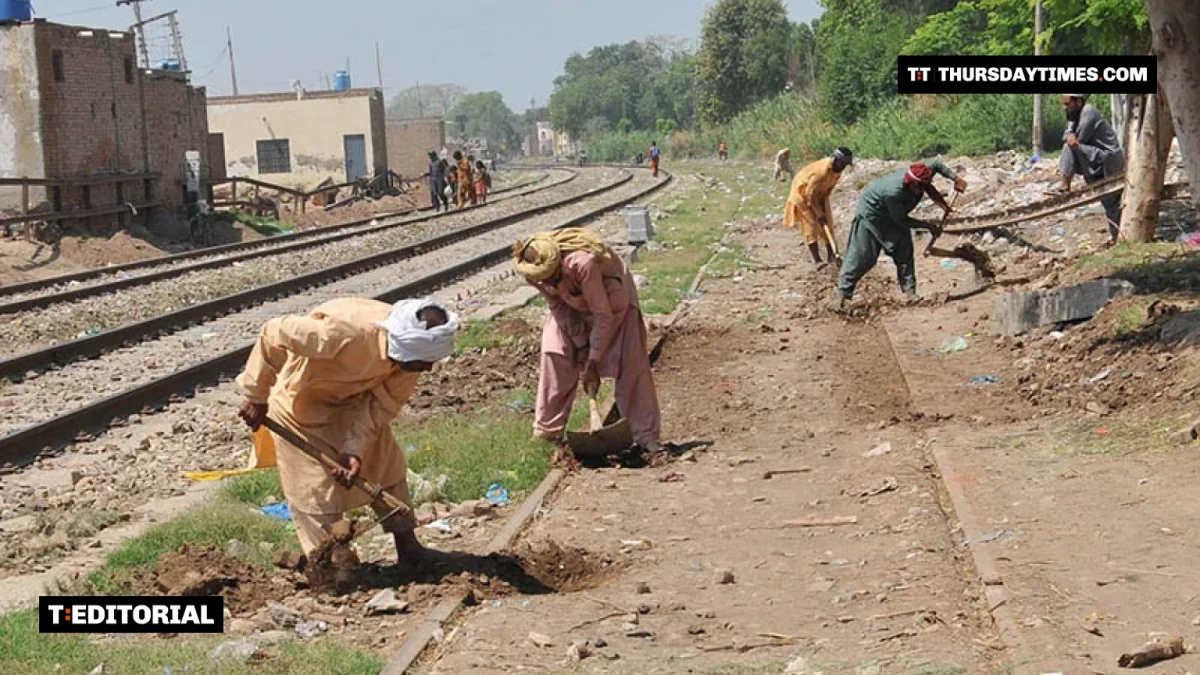
Pakistan Railways deserves credit for reopening the flood-hit Lahore–Faisalabad line in 45 days, against the 60 allowed for the work. The minister has said that about 1,500 feet of track was washed away on July 27 and that the Missan Kalar bridge has been rebuilt. Passengers and freight can move again. But the lesson of a good repair is not that floods are survivable if the crew is quick. It is that every repair we can avoid is worth more than a fast one. This monsoon, like the last, showed where the network is weakest. The country now has the means, and some financing, to build the next line so that it loses less when the rains come.
Credit where it is due
The sequence matters. Federal Railways Minister Hanif Abbasi said the washed-out section had to wait for consultants to be appointed, a feasibility report to be written, and funds to be arranged before work formally began on September 23. In August, when he inspected the collapsed bridge near Missan Kalar, he asked for the feasibility report within 20 days, and reports at the time quoted him as expecting the restoration to take about four months. Counting from the washout to this Sunday’s reopening is about 111 days, so the finished job beat even that early estimate. A private company worked alongside Pakistan Railways. The minister announced cash rewards for everyone involved and called the labourers the real heroes of the project.
That praise is deserved, and it should be said plainly. Public works in Pakistan are often announced with more energy than they are completed. Here a deadline was set, kept, and beaten, and five express services and a goods train have their route back. The institution should want to repeat that, and then ask a harder question: why did a single storm have the power to cut one of the country’s busiest passenger corridors for nearly four months in the first place?
The monsoon keeps coming back
This was not a freak year. Official tallies of the 2026 monsoon passed 100 deaths in late July and had reached about 180 by early September. The year before, the government’s Economic Survey put the monsoon’s toll at 1,039 lives and Rs822 billion in damage, with Punjab taking the largest share. In September 2025, floods forced trains to stop on five sections in Punjab. The pattern is steady enough to plan around, and planners should treat it that way.
The Asian Development Bank puts the average annual loss to floods, earthquakes, and other disasters at about $2 billion. The 2022 floods alone caused $14.9 billion in direct damage and $15.2 billion in economic losses, and pushed as many as 9.1 million people into poverty. Those figures come from the bank’s own announcement of a new $500 million contingent financing facility, approved this month. It is the second subprogram of a climate and disaster resilience program meant to improve preparedness and speed up access to money after a disaster strikes.
What disasters cost Pakistan, in billions of dollars
All bars share one scale. The $2 billion average covers floods, earthquakes, and other disasters. Source: Asian Development Bank.
Set the $0.5 billion facility beside the $2 billion yearly average and the point is clear: contingent money helps, but it is a cushion, not a cure. The cheapest loss is the one that never happens. That is where railways, roads, and bridges come in, because they are the lifelines through which relief, food, and fuel travel when everything else is under water.
A fast repair shows the system can recover. A good embankment shows it has learned.
Build higher, and build wider
The first demand is the simplest to state and the hardest to fund: raise the embankments on the sections that flood. A railway line sits on a raised bank for a reason. If that bank is too low, or built on soil that softens when saturated, water gets over it or under it, and the track goes. Pakistan Railways should publish a list of the flood-prone sections on its network, ranked by how often and how badly each has been hit, and put the worst on a dated schedule for raising, widening, and protecting the banks with stone pitching or similar cover where the current can scour them.
The second demand concerns the openings under the line. A culvertA pipe or small tunnel that carries water under a railway or road. If it is too small or blocked with debris, water backs up behind the embankment and can break through it. or bridge that was sized for the rainfall of decades ago will choke on today’s flows, and a choked opening turns the embankment into a dam. Bridges and culverts on flood-prone sections should be checked against recent monsoon flows, not old design tables, and replaced or widened where they fall short. The bridge near Missan Kalar is a reminder of what is at stake: a single structure can cut a corridor in two.
None of this is cheap, and it should not be pretended otherwise. But the costs can be staged. Start with the stretches that have already failed, because the failure has already told engineers where the water goes. Fix those first, and use the repair experience to set standard designs for the rest. The same crew that restored the line in 45 days can write the specification for the line that does not wash away.
Warnings that reach the track
The second set of changes costs far less than concrete. The Pakistan Meteorological Department forecasts the rain, the National Disaster Management Authority tracks the damage, and the provincial disaster authorities coordinate the response. Railways and the National Highway Authority run the assets in the water’s path. Each of these bodies issues warnings, yet it is not clear that a warning from the first group reaches a station master, a track supervisor, or a toll-plaza manager in a form they can act on within hours.
A formal link would fix that. When the forecasters raise an alert for a river basin, the railway control rooms and highway patrols on that basin should receive it automatically, with a named person responsible for acting on it. Trains can be held or rerouted before a bridge is tested. Speed restrictions can be placed on a weakened section. Patrols can be sent to the known weak points while there is still daylight. Pakistan has itself called for seamless disaster coordination; this is what that looks like at the level of one track.
The cheapest flood defence is a warning that reaches the person who can stop the train.
Stock the shelves before the rain
A great deal of the time between the washout and the reopening went on preparation, not construction. By the minister’s own account, consultants had to be hired, a feasibility study written, and funds found before work started on September 23. That is a normal government sequence, but it is a slow one for an emergency. Railways and the highway authority should hold pre-positioned stocks of the things that every repair needs: ballast, sleepers, rails, bridge girders, and gabions, spread across the regions rather than kept in one yard. Framework contracts with engineering firms, signed before the season, would allow work to begin within days of a washout instead of weeks.
The same principle applies to money. The ADB’s contingent facility is released as budget support soon after an eligible disaster, and its director for Pakistan has said that investing in preparedness protects lives and livelihoods and reduces economic losses. The federal and provincial governments should do the same with their own budgets, and set aside an emergency repair reserve for transport infrastructure. A ministry that knows funds are waiting will not need to arrange them after the water has gone.
Insure what cannot be moved
Track, bridges, and signals cannot be moved out of a river’s way. They can be insured. A national scheme for public infrastructure, using the damage data the disaster authorities gather and the post-disaster needs assessmentsA joint government and development-partner estimate, made after a major disaster, of the damage done, the losses suffered, and the money needed to rebuild. Pakistan used one after the 2022 floods. Pakistan has produced after major floods, would put a price on risk before the flood, not after it. Premiums would reward the sections that are raised and protected, and charge more for those that are not. That is how a discipline spreads: not through circulars, but through cost.
There is a quieter benefit. Insurers and lenders ask for data. A railway network that has to show which sections flood, how often, and how much each repair cost will be a better-managed railway. The same applies to the highways. Pakistan’s long-term plan to upgrade the Rohri–Karachi track and to finance the 449-kilometre Rohri–Multan line, which the minister has described, offers a chance to put resilience requirements into the contracts from the first day, instead of retrofitting them after the next storm.
Make this the standard, not the exception
None of this undoes the achievement of the last 45 days. It builds on it. A railway that can restore a washed-out section ahead of schedule has shown that it can plan, contract, and deliver. The question for the coming year is whether that ability is turned toward prevention. The minister has also said that production of safety brackets and other parts has restarted at a workshop that was shut for years, and that all 43 of the locomotives that have been running short of traction motors would be fully equipped by December 15. A department that is repairing its own fleet and workshops is a department that can take on its own flood defences.
Four things would show that the lesson has been learned. First, a published list of flood-prone sections with dates for raising each one. Second, bridges and culverts rechecked against recent flows. Third, a standing warning link between the forecasters, the disaster authorities, the railways, and the highways. Fourth, stocks, contracts, and a reserve in place before next July. Each is within the means of the institutions that already exist.
Pakistan cannot stop the monsoon. It can decide how much of the country the monsoon takes with it. The workers who rebuilt the track at Missan Kalar did their part. The next monsoon will test everyone else.