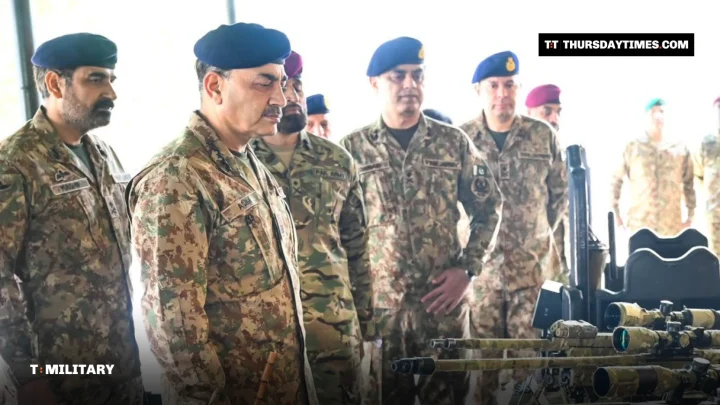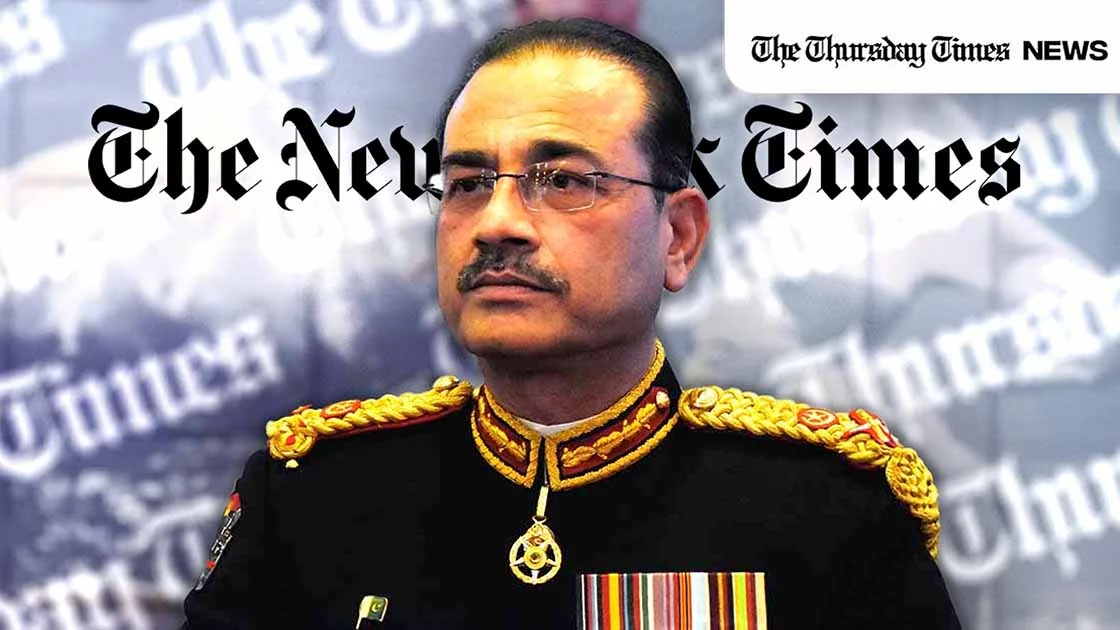
New York (The Thursday Times) — According to the American newspaper The New York Times, Pakistan's Army Chief General Syed Asim Munir, who usually works behind the scenes, now appears to be playing a central role amid rising tensions with India. He is seen not only taking an active part in military exercises but also setting a new policy direction in strong language.
From power behind the scenes to the public stage
General Asim Munir used to keep himself out of public view, making only formal statements at scheduled military events. But in recent weeks, following the terrorist incident in Indian-administered Kashmir, the picture has changed.
After the killing of nearly two dozen Hindu tourists, intense public pressure emerged in India. In these circumstances General Munir hardened Pakistan's tone and, standing atop a tank during a training exercise, warned the troops that any Indian aggression would be met with an “immediate, decisive and enhanced response”.
Ideological narrative and anti-India policy
The New York Times wrote that General Asim Munir's position is not merely a political strategy but has an ideological foundation. He headed sensitive institutions such as the ISI and MI, and his views reflect an anti-India stance rooted in religion.
Describing Kashmir as the “jugular vein” is not merely a symbolic statement but the historical basis of Pakistan's national narrative. India's Ministry of External Affairs called it provocative and described Kashmir as an “integral part” of India.
Diplomacy versus the military narrative
General Asim Munir's policy is clearly hardline, while the United States, the United Nations and China are engaged in efforts to reduce tension in the region. Pakistan's Permanent Representative to the United Nations, Asim Ahmad, has said that Pakistan has discussed the fresh tension with Chinese officials.
Meanwhile, Indian Prime Minister Narendra Modi is hardening his rhetoric further, presenting the Muslim population and Pakistan as an internal and external threat.
Past experience and present strategy
After the 2019 attack in Kashmir, India carried out air strikes, which brought the region to the brink of war. General Munir was then head of the ISI, but a few months later Prime Minister Imran Khan removed him from the post.
Religious inclination and military policies
General Munir's speeches are clear, blunt and full of religious references. According to Husain Haqqani, a former Pakistani ambassador to the United States, General Munir is an officer of religious inclination, and his thinking on India is extremely narrow and hardline.
A dangerous turn in tensions
To gain institutional control over any process of talks with India, the Pakistani army has appointed the head of the intelligence agency as national security adviser, a post previously held by retired generals or civilians.
At present, diplomatic relations between the two countries are suspended, and harsh public statements have become the only means of communication. The "New York Times" has warned that in this climate the risk of miscalculation is high, and that even a minor attack could escalate into a major confrontation.
Security analysts in Islamabad say that if India takes military action, Pakistan will have to respond. In their words, the question is whether or not Modi decides to stop here.