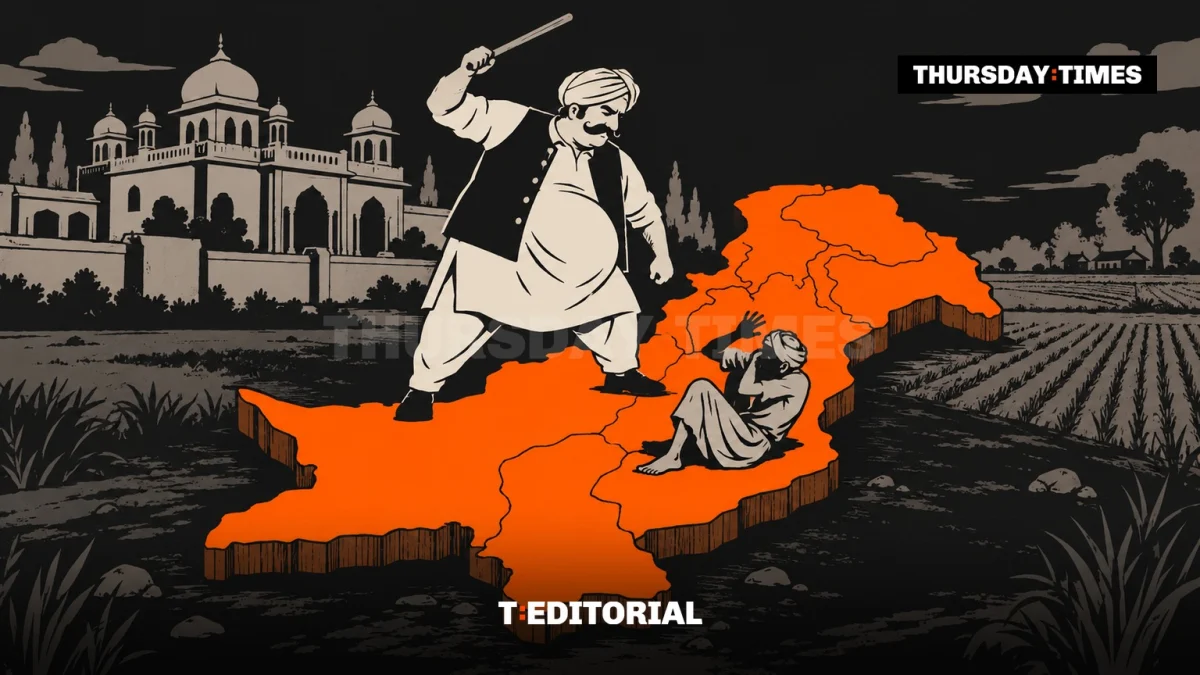
Pakistan does not have four provinces. It has four estates, and the men who own them would rather watch the country fail than redraw a single line.
Start with the arithmetic, because arithmetic does not care who your grandfather was.
Punjab holds nearly 128 million people, roughly as many as Japan, and every one of them is governed from a single secretariat in Lahore. Balochistan covers almost half the country with under 15 million. Pakistan’s population has grown more than sevenfold since 1951, and in all that time the country has lost a wing, swallowed the tribal districts and rewritten its constitution. The provinces have not moved.
Population, by province
Balochistan covers almost half of Pakistan’s land.
No engineer would design this map. No economist would defend it. Only a landlord could love it.
The debate is back, and this time even the government is saying it out loud. The Interior Minister wants an administrative reset. The Planning Minister has floated splitting every province into three. The MQM-P wants a national dialogue, Parliament has been promised a debate this month, and a World Economic Forum paper published in October says Pakistan could run on anywhere from 16 to more than 30 first-tier units. Everyone agrees the system is failing. Almost nobody with power wants to fix it. Ask yourself why.
The man at the door
Every region has a name for him. In central Punjab he is the chaudhriRoughly: a landowning strongman, the top rung of rural Punjab’s caste hierarchy.. In the south he is the makhdoomRoughly: a hereditary spiritual master, often head of a Sufi shrine., the pirRoughly: a Sufi spiritual guide, revered as a living saint., the gaddi nashinLiterally “one who sits on the seat” — a shrine’s hereditary custodian. who inherited the land, the shrine and the assembly seat in a single bequest. In Dera Ghazi Khan and Rajanpur he is the tumandarRoughly: a tribal chief, in the Baloch-Seraiki frontier belt.. In Sindh he is the waderaRoughly: a feudal landlord — Sindh’s term for the big man.. In Balochistan, the sardarRoughly: a tribal chief, in Balochistan. or the nawabRoughly: a hereditary nobleman or prince.. In Khyber Pakhtunkhwa, the khanRoughly: a chief or leader, in Khyber Pakhtunkhwa. or the malikRoughly: a village headman.. Different titles. Same racket.
The numbers are not rhetoric. UNDP’s National Human Development Report found Pakistan’s elites, feudal landlords among them, capturing some $17.4 billion a year in privileges, about six per cent of the entire economy. It found a landed class of roughly one per cent of the population holding about 22 per cent of cultivable land. The 2024 Agricultural Census confirms it from the bottom: 97 per cent of farmers own less than 12.5 acres. In Sindh, 0.3 per cent of farms swallow 15 per cent of all farm area, averaging 230 acres apiece.
Who holds the land
Source: UNDP National Human Development Report.
Land on that scale is not wealth. It is a vote bank with a fence around it. The haariRoughly: a tenant farmer or sharecropper, in Sindh. who tills it votes the way the landlord votes, because the landlord owns the road to everything the state is supposed to give him for free: the FIR at the thanaRoughly: a police station., the entry in the patwariRoughly: the village official who keeps the land records.’s register, the hospital bed, the teaching post, the water in the canal.
And that racket runs on one thing: distance. When the provincial capital is a day’s journey away and the chief minister will never set foot in your tehsil, the big man in the haveli becomes the only door to the state. He is a toll booth, and the longer the road to the capital, the higher the toll. He does not need you educated. He needs you to need him.
“He does not need you educated. He needs you to need him.”
Smaller provinces shorten the road. Put a capital in Multan or Bahawalpur, give the south an assembly where it is the majority instead of a footnote, and post officers who live among the people they govern, and the toll booth starts to look like what it is: a middleman nobody needs. That is the entire reason the middlemen have spent forty years making sure it never happens.
Yes means never
The landed class almost never says no to new provinces. It is far too clever for that. It says yes, at the top of its voice, every five years, and then it buries the idea between elections.
Look at the record in south Punjab. In 2012 the Punjab Assembly and the National Assembly both passed resolutions for a new province. A Senate bill cleared with a two-thirds majority and was left to die in the lower house. In 2018 a bloc of south Punjab electables walked out of the PML-N, christened themselves the Janoobi Punjab SubaRoughly: province. Mahaz, and merged into the PTI on a written promise to set the province in motion within 100 days. The PTI took 30 of the region’s 50 National Assembly seats. The province never came. South Punjab got a sub-secretariat in 2020: a branch office of Lahore with a fresh coat of paint.
“The suba is a cash crop. It is planted at every election, harvested at the ballot box and ploughed back under the day the results are in.”
The subaRoughly: province. is a cash crop. It is planted at every election, harvested at the ballot box and ploughed back under the day the results are in. The men it elects then sit in Lahore’s assembly, in Lahore’s cabinet, at Lahore’s budget table. Why would a makhdoom who has made himself indispensable to a faraway capital want one next door, where his constituents could knock?
Then there is the hypocrisy. The PPP has sponsored bill after bill to carve a province out of Punjab, and its chairman campaigned in Multan on the promise of one. Ask the same party about Sindh and the doors slam shut. On 3 September the Sindh Assembly unanimously rejected any division of the province, invoking its veto under Article 239(4), in a line of such resolutions going back to 1948. The Chief Minister said the decision belonged to Sindh’s legislators, “not businessmen from Lahore.” Divide Punjab, never Sindh. That is not a principle. It is a property line.
He is right that it is Sindh’s decision. He is wrong about who Sindh is. The unity defended in that chamber is not the unity of the families of Tharparkar and Thatta, who have been failed by every provincial government they have ever had. It is the unity of an estate: land, votes and office held in the same few hands since before Partition, in the province with the most concentrated landholding of any large one in Pakistan. “Sindh’s integrity” is the wadera’s integrity, wearing an ajrakRoughly: a traditional Sindhi block-printed shawl, a symbol of Sindhi identity..
“‘Sindh’s integrity’ is the wadera’s integrity, wearing an ajrak.”
And when people demand a province from below rather than from the drawing room, the state has answered with bullets. In April 2010, when Hazara rose against the renaming of the NWFP and demanded its own province, police opened fire in Abbottabad. At least seven people were killed. Nobody answered the movement. They simply waited for it to tire.
Farm size, to scale
Source: Pakistan Agricultural Census, 2024.
Every excuse, and why it is an excuse
“It will tear the country apart along ethnic lines.”
Only if provinces are drawn on ethnic lines, and nobody serious is proposing that. The case is administrative: population, distance, the time it takes a mother to reach a hospital. India runs on 28 states, has carved out new ones from Uttarakhand to Telangana, and is still one country. If more units meant more division, it would have shattered decades ago. What breeds separatism is the map we have now, which locks entire regions into permanent minority status inside their own provinces and then acts surprised when they get angry.
“It is an establishment plot to gut the 18th Amendment.”
This is the strongest argument the status quo has, so take it seriously, and then take it apart. Yes, reporting on the proposed 28th Amendment suggests it could loosen the provinces’ guaranteed share of the NFC award. If new provinces become a Trojan horse for recentralising power in Islamabad, they should be fought in the streets. So tie the reform’s hands before it moves an inch: the NFC floor untouched, devolution intact, and Article 140A finally enforced so that power reaches union councils instead of stopping at a new chief minister’s desk. Then watch who still objects. Provincial autonomy that ends at the chief minister’s office is not autonomy. It is centralisation with a shorter commute. The people waving the 18th Amendment loudest have sat on its local government clause for sixteen years.
“We cannot afford it.”
New secretariats and high courts cost money. The status quo costs more, and it is paid in stunted children, unschooled girls and districts still waiting, seventy years on, for a hospital that works. The question was never whether reform is expensive. It is who has been paying for its absence, and it has never been the man in the haveli.
“The Constitution forbids it.”
It does not. Article 239(4) requires two-thirds of the affected provincial assembly, and it should stay exactly as it is: a reform forced through over the heads of elected assemblies would hand the feudal class the one thing it lacks, a righteous cause. 239(4) is a lock, not a wall, and every lock has a key. The key is the voter. Hold referendums that show legislators what their constituents actually want. Make every party that promises a province and fails to deliver pay for it at the next election. A lawmaker who can veto a province can also be voted out for doing it.
“Provincial autonomy that ends at the chief minister’s office is not autonomy. It is centralisation with a shorter commute.”
Stop asking their permission
The four-province map was not handed down from heaven. It is the residue of colonial convenience and post-Partition bargains, kept alive because it works beautifully for the few hundred families who sit on top of it. The chaudhri, the wadera, the makhdoom and the sardar do not oppose new provinces because they will divide Pakistan. They oppose them because they will divide their Pakistan: their monopoly on access, their seat at a distant table, their role as the only door to the state.
A country of 250 million people cannot be run as four fiefdoms and a flag. Pakistan needs more provinces, drawn for governance and armoured with real devolution. The men who say “not now” have been saying it for forty years, and they will say it for forty more. The haari has waited long enough for a capital he can reach. Give him one.