WASHINGTON (The Thursday Times) — In the four days since Democrats won both houses of Congress, President Donald Trump has promoted his most combative adviser to run the White House, ordered the Justice Department to investigate the Democrats he says are threatening his allies, and offered the job of press secretary to the head of a cage-fighting promotion. Each move has its own story. Taken together, they point in one direction. Trump is not reaching across to the Congress he will face in January. He is closing ranks around the people he trusts most, and preparing for a fight.
That is not the only path open to a president who has just lost his majorities. Some of his predecessors answered a midterm defeat by bringing in a conciliator, firing an unpopular aide or promising to work with the other side. Trump did say, on election night, that he looked forward to working with Democrats “for the good of our country”. But he added in the same breath that he had “total veto power”, and that if Democrats would not work with him, “I’d just veto everything”. The appointments of the past four days suggest which half of that message he meant.
Four days after the midterms
1. The gatekeeper
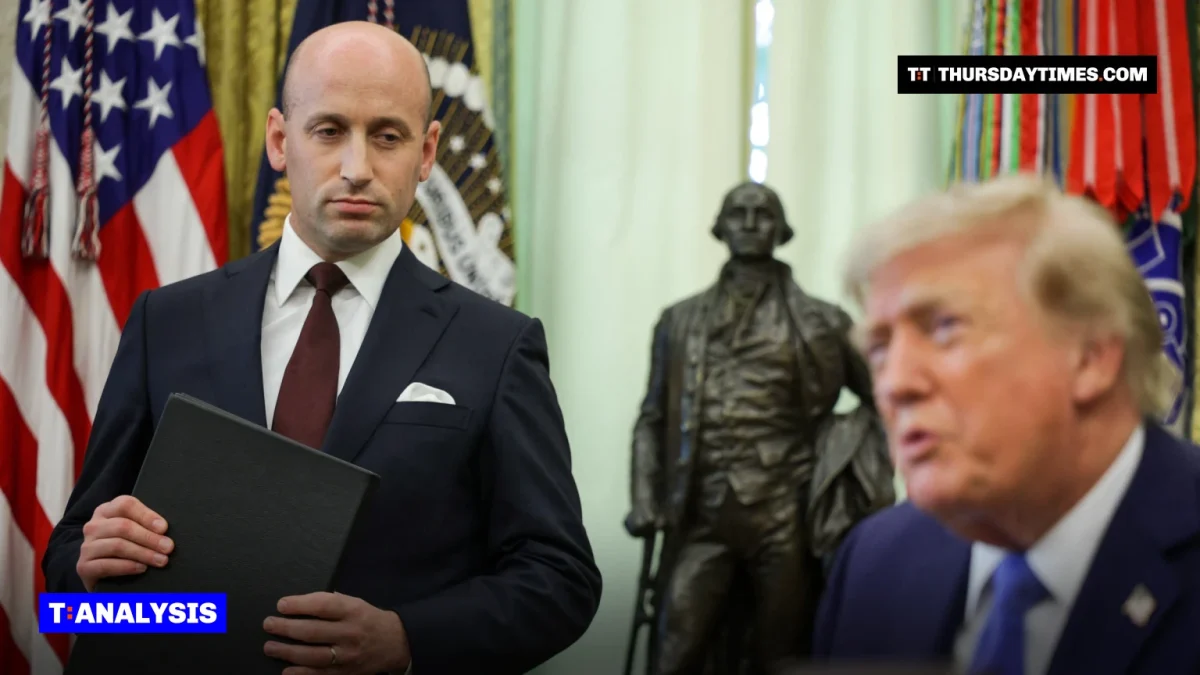
The most consequential change is the least theatrical. On Friday Trump named Stephen Miller, his deputy chief of staff and homeland security adviser, as chief of staffThe president’s most senior aide, who runs the White House staff, controls who and what reaches the president, and usually leads negotiations with Congress. from Monday. Miller replaces Susie Wiles, who ran Trump’s 2024 campaign, became the first woman to hold the post and is moving to the president’s political operation.
The two could hardly be more different. Wiles was valued for discipline and for keeping the peace inside a crowded White House. Miller has been at Trump’s side since the 2016 campaign and is the architect of the administration’s immigration crackdown and deportation programme. He is widely disliked by Democrats, who will soon run every committee in Congress. Trump called him “one of my most trusted advisors”.
A chief of staff is usually the White House’s main negotiator with Capitol Hill. Choosing Miller for that job, at the moment Democrats take control of the Hill, signals that the White House expects confrontation, not bargaining. As recently as mid-October, Trump dismissed talk of replacing Wiles as “fake news”. Three weeks and one election later, she was gone.
Wiles left gracefully. “Serving President Trump in the White House has been the honor of a lifetime,” she wrote on X. “While my role may be changing, my commitment to the president and the mission never will.” Her move to the political operation keeps her inside the tent, where she will matter again as the 2028 race takes shape.
Trump is not reaching across to the Congress he will face in January. He is closing ranks.
2. The prosecutors
On Saturday Trump went further. In a post on Truth Social he accused Democrats of “extortion at the highest level”, saying they were threatening the attorney general, Republican donors and young conservatives with impeachmentThe House of Representatives charging an official with wrongdoing by a simple majority. Removal from office then needs a two-thirds vote in the Senate. and prison. “By copy of this statement, I am ordering the Department of Justice to look into this criminal act, immediately!” he wrote. He did not say who had sent the “threatening letters” he described, or who had received them.
He singled out Senator Elissa Slotkin of Michigan, claiming she was “going to go after all young people that believe in Republican Values”. Slotkin had said in October that she wanted young graduates to think twice about working for the Trump administration because of the legal risks involved: “I want that deterrence message.” Trump offered no evidence that she had said what he claimed.
The attorney general he wants to protect is Todd Blanche, his former personal lawyer, whom the Senate confirmed by 50 votes to 49 in August after Trump fired Pam Bondi. The order fits a pattern. A year ago Trump called a video in which Slotkin and five other Democrats urged troops to refuse unlawful orders “SEDITIOUS BEHAVIOR, punishable by DEATH!”, and the Justice Department later failed to secure indictments over it. Directing prosecutors at opponents is a way of changing the subject from what the new Congress plans to investigate to what the president says his opponents have done.
3. The podium
The third move was the strangest. Trump announced that “the Great Dana White, a violent Fighter and Warrior”, had been offered the job of press secretary, and asked him to bring six fighters as assistants: Islam Makhachev, Khabib Nurmagomedov, Justin Gaethje, Daniel Cormier, Amanda Nunes and Kayla Harrison. “We need these people to defend us against the Lunatic Left,” he wrote. “Dana, please take the job!”
White, the chief executive of the UFC, is not a fighter. He is one of Trump’s longest-standing friends in sport, spoke for him at three Republican conventions and staged a card on the White House South Lawn in June for his 80th birthday. Whether he takes the job or not, the offer matters for what it says about the mood. The press secretary’s podium has been without a settled occupant since Karoline Leavitt left at the end of August. In October, White House officials said Katie Zacharia, a communications adviser at Trump Media, would replace her. Trump’s post did not mention Zacharia. The language of the offer, with its fighters and its enemies, describes a White House preparing for combat with the press and with Congress, not a reset.
4. The doubters
Not everyone around Trump reads the defeat the same way. Vice President JD Vance was blunt the day after the vote. “The reason we lost is the war,” he wrote, citing a pollster whose findings he did not publish: Trump voters who switched to Democrats wanted the war with Iran ended, a focus on prices, “America First” and a change in the relationship with Israel. Trump has been more equivocal. “A part of it was Iran,” he said, but “I don’t think it’s the war. I think it’s a gasoline price.” The war, he added, would end “when I say it ends”.
Secretary of State Marco Rubio, who is also Trump’s national security adviserThe president’s chief adviser on foreign policy and security, who runs the National Security Council staff. Rubio has held the post alongside his job as secretary of state., was reported on Thursday to be weighing whether to leave, according to people familiar with the matter. The State Department called the report “complete and total fake news”. Whatever the truth, the speculation itself shows how unsettled the administration is: its vice president is publicly blaming the president’s war for the defeat, and its top diplomat has had to deny he is on his way out.
Its vice president is blaming the war for the defeat, and its top diplomat has had to deny he is leaving.
5. What Democrats can do
From January, Democrats will hold majorities in both chambers and every committee, with the power to issue subpoenasLegal orders compelling a person to testify or hand over documents. Congressional committees can issue them, and ignoring one can lead to contempt proceedings., open investigations and block the president’s nominees, including to the courts. “Lawyer up,” wrote Robert Garcia, the congressman expected to lead the House Oversight Committee. Party leaders have signalled inquiries into the administration’s handling of the Epstein files and Trump’s business interests.
Their limits are as important as their powers. Democrats lack the two-thirds majorities needed to override a veto, so any law they pass still needs Trump’s signature. The House can impeach an official by a simple majority, but removal needs two-thirds of the Senate, which Democrats do not have. The likeliest result is a long stand-off: investigations from Congress, vetoes and counter-accusations from the White House, and very little new law.
What the new Congress can and cannot do
Trump’s appointments suggest he has accepted that and chosen his ground. A chief of staff who relishes confrontation, a Justice Department pointed at his critics and a press operation framed as a fight are the tools of a White House that expects to spend the next two years defending itself, and attacking.
6. What it means for Pakistan
For Pakistan the most important question is not who stands at the White House podium. It is what happens to the war with Iran, in which Islamabad has been a central go-between, and to the channels that run through the people Trump trusts.
On the war, the signals are mixed. Vance’s reading of the defeat strengthens those inside the administration who want a settlement, and Iran’s parliament speaker has already read the result as Americans saying “no to war”. Trump, though, insists the decision on Iran was correct and that he alone will decide when the war ends. A smaller circle around the president, led by a chief of staff focused on immigration and domestic enemies, may leave foreign policy more than ever in Trump’s own hands. That cuts both ways for Pakistan. Direct access to the president, which Pakistan’s leadership has built over the past year, matters more when fewer voices stand between him and a decision.
Rubio is the other variable. As both secretary of state and national security adviser he has been a fixed point for every government dealing with Washington on Iran and the Gulf. If he were to leave, Pakistan, like others, would need to rebuild working relationships at a sensitive time. For now he is staying, and the State Department says he will remain “long after this fake news is revealed”.
Congress changing hands was never likely to rewrite US-Pakistan ties on its own. The changes inside the White House are more immediate. For Islamabad, the task is to keep the channels to the president open, keep the mediation on Iran moving, and avoid being drawn into the fight that Trump is now visibly preparing for at home.