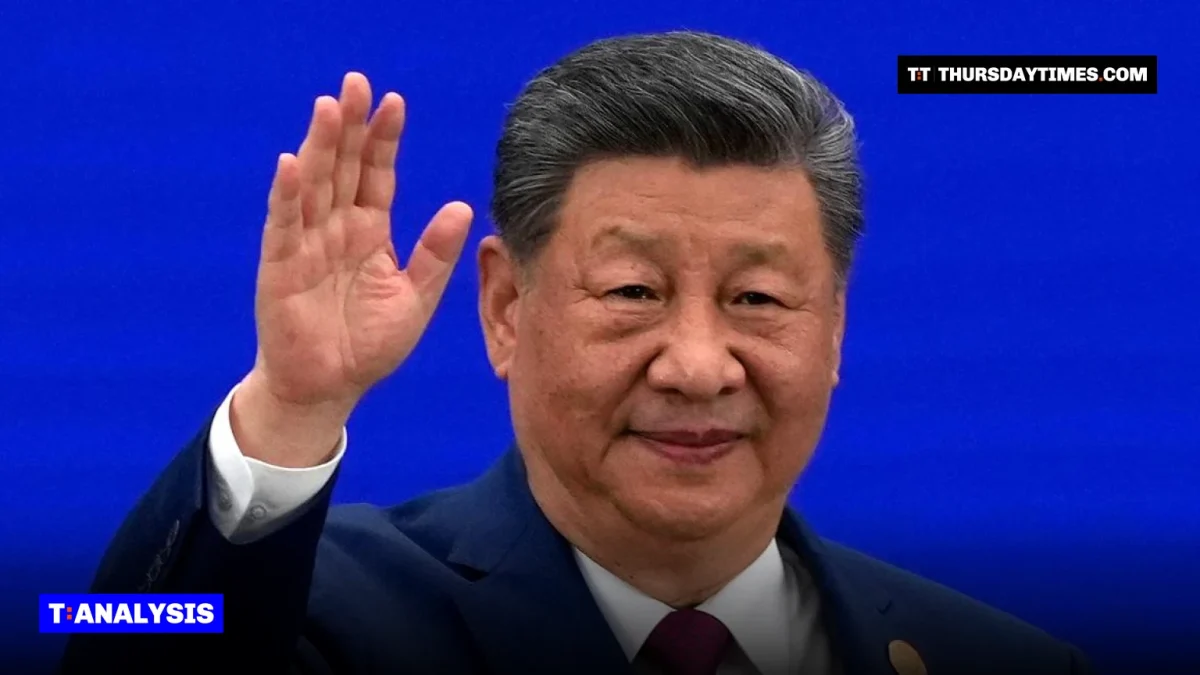
BEIJING (The Thursday Times) — Xi Jinping spoke to two audiences on Thursday. At the Great Hall of the People, at a ceremony for the 160th anniversary of the birth of Sun Yat-sen, China’s president said that resolving the Taiwan question was an “unwavering historical mission” of the Communist Party, that reunification “must be realised, and it will certainly be realised”, and that “the tide of history cannot be stopped”. The first audience was at home and across the Taiwan Strait. The second was in Washington. In a week, Xi is due to sit down with President Donald Trump at the Asia-Pacific Economic Cooperation summit in Shenzhen, and the speech made clear, before a word is spoken there, what Beijing does not intend to trade.
Old words, new timing
Little in the speech was new. Xi repeated China’s offer of “peaceful reunification” under one country, two systemsThe arrangement under which Hong Kong returned to Chinese rule in 1997, keeping its own legal and economic system for 50 years. Beijing offers Taiwan a version of it. Taiwan’s main parties reject it., and called on people on both sides of the strait to oppose what Beijing calls separatist forces. He did not mention the use of force, which China has never renounced.
Taiwan’s Mainland Affairs Council, which handles relations with Beijing, said the wording was not much different from the past. It rejected the offer outright. “The PRC has never ruled Taiwan for a single day,” the council said, and it urged Beijing to recognise that the Republic of China still exists and to respect the island’s democracy and its 23 million people.
What gave the speech its weight was the setting. Sun led the 1911 revolution that ended imperial rule in China and founded the Kuomintang, now in opposition in Taiwan, and he is honoured on both sides of the strait. Beijing uses his anniversaries to present the Communist Party as his rightful heir. Taipei, which counts this year as his 161st by its own reckoning, had told its citizens not to travel to the mainland for the commemorations, accusing Beijing of distorting history. On the day of the speech, Taiwan’s defence ministry reported 29 Chinese military aircraft, including J-16 fighters and drones, on a joint combat readiness patrolTaiwan’s term for exercises in which Chinese aircraft and warships operate together around the island, rehearsing the kind of coordination a blockade or attack would need. with Chinese warships around the island. Taiwan holds local elections in a little over two weeks.
A frozen arms sale has bought calm in the strait. It has not bought any give on sovereignty.
Three meetings in six months
Shenzhen will be the third meeting between the two leaders this year, and each has turned on Taiwan more than either side likes to say in public.
Shenzhen may yet become something larger. China said on Thursday that it was in contact with other parties about a possible meeting of Xi, Trump, and Russia’s Vladimir Putin, which Secretary of State Marco Rubio had raised with Foreign Minister Wang Yi the day before. Xi is also expected in Florida for the G20 summit in December. Taiwan will hang over all of it. On the same day as the speech, Beijing rejected a statement by G7 foreign ministers on Chinese activity in the waters east of the island as gross interference in its internal affairs.
The arms package is the clearest sign of how far Washington has moved. It is separate from an $11.1 billion package approved in December 2025, and it has been frozen since May. Trump’s description of it as a bargaining chip alarmed lawmakers in both parties, who argue that it sits uneasily with the Six AssurancesCommitments the United States gave Taiwan in 1982, including that it would not set an end date for arms sales and would not consult Beijing about them. Washington gave Taipei in 1982, among them a promise not to consult Beijing on arms sales. Administration officials have offered other reasons. Before Xi’s visit in September, a senior US official said that more American weapons for Taiwan could prompt China to send more weapons to Iran.
The strait in four numbers
Sources: US officials; Taiwan’s defence ministry; Taiwan’s Mainland Affairs Council.
Beijing has read the pause as a signal, and Thursday’s speech was its reply. Restating China’s claim in the strongest terms a week before the summit tells Trump that a frozen arms sale can buy a quieter strait, but not a softer position on sovereignty. What Beijing wants next is a change of words. Washington says it does not support Taiwanese independence. China would like it to say it opposes it. That one verb would matter more in Taipei than any tariff line agreed in Shenzhen.
Iran is in the room
The two governments now discuss Taiwan with another war in the background. The fighting that began on February 28 has disrupted shipping through the Strait of Hormuz for most of the year. Washington has asked Beijing to use its influence with Tehran to help end it, a request China has passed on. US officials have also accused China of giving Iran help that has cost American lives, and want it stopped. China, for its part, has long been the main buyer of Iranian oil and needs the Gulf’s sea lanes open.
That gives each leader something the other wants. Trump wants Chinese pressure on Tehran and an end to the assistance his officials complain about. Xi wants the arms package to stay frozen and American language that leans further against Taiwanese independence. The danger for Taipei is that its security becomes one line in a larger bargain about a war it has no part in.
Trump may have made that bargain harder to strike. In a post on Thursday, he wrote, “We don’t need a deal with Iran,” and said the United States already had Iran’s money and its strait. If Washington no longer wants a settlement, it needs Beijing’s help less, and has less reason to pay for it with concessions on Taiwan. If the post is a negotiating posture rather than a policy, the trade is still on the table.
Taiwan’s security risks becoming one line in a larger bargain about a war it has no part in.
Chips, the other front
Technology is the other front, and Taiwan sits at its centre, because its factories make the most advanced chips that artificial intelligence runs on, including Nvidia’s. The fight over who may buy those chips has already reshaped one of America’s most valuable companies.
China’s share of Nvidia’s revenue
China, including Hong Kong, as a share of Nvidia’s total revenue. The first broad US export controls on advanced chips to China took effect in October 2022. Source: Nvidia’s financial reports.
Trump loosened the rules last December, letting Nvidia sell its H200 chips to approved Chinese buyers with the US government taking a 25% cut. Washington has since licensed sales to Alibaba, Tencent, ByteDance, and others, but Beijing has not approved large-scale imports, and H200 shipments to China made up less than 1% of Nvidia’s data-centre revenue in the quarter to July.
On Thursday, Jensen Huang resigned as Nvidia’s chief executive after reports of an affair with a woman US officials believe was a Chinese intelligence asset, a claim Beijing calls baseless. Huang had been the most persistent voice in Washington for selling to China. With him gone, and with Democrats taking control of both chambers of Congress in January and promising to investigate Nvidia’s China ties, Trump has less room to offer chip access as a sweetener in Shenzhen. Beijing has already pushed back, with its foreign ministry telling Washington on Thursday to stop “fabricating” spy narratives as a pretext for technology restrictions. US officials said in September that they had no interest in easing export controls. Trade, tariffs, and rare earths look like safer ground for anything the two leaders announce.
What it means for Pakistan
Few countries have a more direct stake in how Shenzhen goes than Pakistan, and its stake is in calm. China is its closest partner, its main source of infrastructure investment through the CPECThe China-Pakistan Economic Corridor, a package of Chinese-backed roads, power plants, and ports, including Gwadar, launched in 2015. programme, and a partner in its defence. The United States is its biggest single export market and, this year, its partner in the search for an end to the Iran war, a search in which Islamabad hosted the talks that produced the June memorandum.
On Taiwan, Islamabad’s position is settled. It regards the island as an inalienable part of China and supports the One-China policy without reservation, a view President Asif Ali Zardari and Prime Minister Shehbaz Sharif have both restated. Last month that commitment took a practical form, when Pakistan closed its airspace to Taiwanese airlines, in what appeared to be the first such step by any country, and then renewed their permits days later. The episode showed how a principle Pakistan has held for decades can, at a tense moment, become a question of daily operations.
Pakistan does best when Washington and Beijing are talking, not when it is asked to choose between them.
The larger interest is that the two powers keep talking. Pakistan does best when Washington and Beijing manage their differences, what both sides called “constructive strategic stability” in September, and worst when they do not. A summit that steadies relations makes it easier for Pakistan to keep CPEC moving and American markets open, and to keep both powers invested in an Iran settlement that would bring down fuel prices at home. Next year, Pakistan hosts the Shanghai Cooperation Organisation summit, which will bring China’s leaders to Islamabad, and its standing with both capitals will be on display.
A breakdown over Taiwan would do the reverse. A crisis in the strait would raise shipping and insurance costs across Asia, slow investment, and push Washington to ask its partners where they stand. Pakistan has already answered that question on Taiwan, clearly and consistently. Its interest is that no one needs to ask it.
What to watch
The first test is the words. If the meeting in Shenzhen goes ahead as planned, watch what each side says about Taiwan afterwards. Any American statement that moves from not supporting independence towards opposing it would be the most significant shift in US policy on the island in decades, and Taipei would treat it as one.
The second is the arms package. If it stays frozen past the summit, Taipei and its supporters in Congress will press harder for its release, and from January a Democratic Congress will have the power to hold hearings on it.
The third is Iran. If Beijing’s help in the Gulf becomes part of the price for American restraint over Taiwan, the strait off Iran and the strait off China will be linked in a way neither government will say out loud. Xi set out his opening position on Thursday. What Shenzhen will show is how much Trump is willing to offer for help in the Gulf, and what he is not.